Peter Parker: The Science Educator
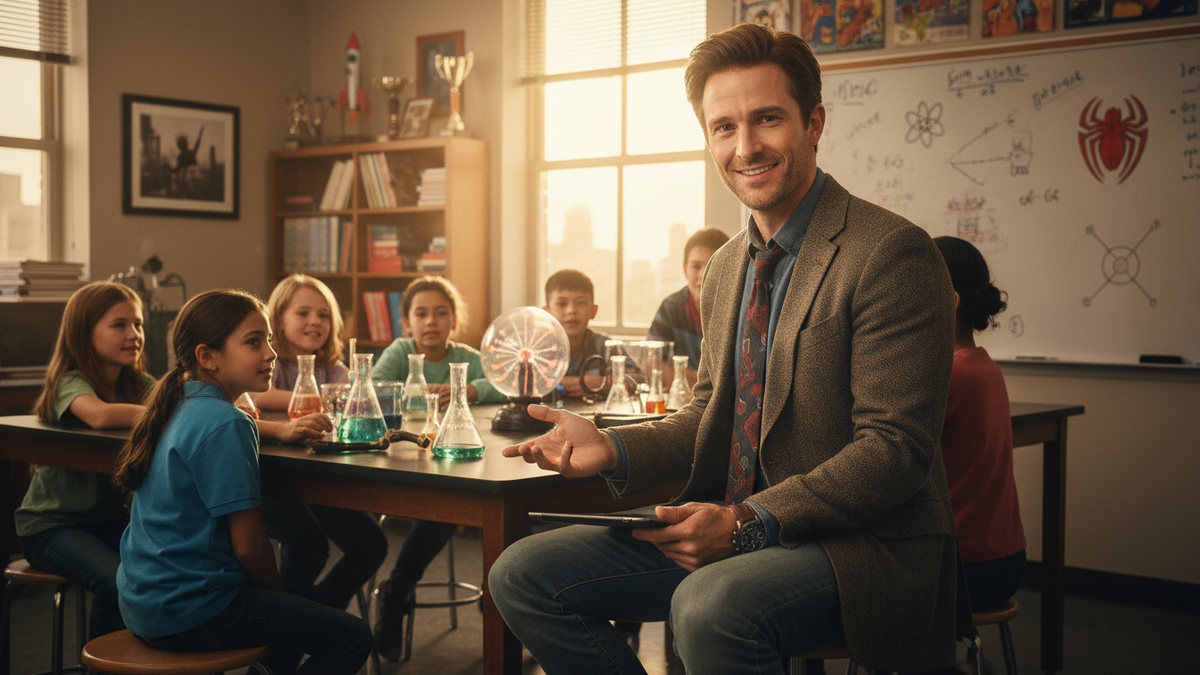
In a high school classroom in Queens, Peter Parker demonstrates a chemical reaction to a group of wide-eyed sophomores. The mixture changes color dramatically, and the students lean forward with excitement. This moment—the spark of curiosity, the instant when science becomes wonder—is why Peter teaches.
“I used to think being Spider-Man was the most important thing I could do,” Peter says during his lunch break, grading lab reports. “And it mattered, it still does. But reaching a kid who thinks they’re not ‘science-smart’ and showing them they absolutely are? That has its own kind of impact.”
His path to teaching wasn’t direct. After years of balancing superhero work with various jobs—photographer, researcher, even a brief stint at Stark Industries—Peter realized what truly energized him was sharing his love of science. Mentoring young heroes like Miles Morales only reinforced that instinct.
“I had incredible teachers growing up. People who saw potential in a nerdy kid from Queens and nurtured it. Without them, I don’t know who I’d be. Maybe I’d still have powers, but I wouldn’t have known what to do with them. I wanted to be that person for other kids.”
He teaches chemistry and physics at the same school he attended as a student, which adds layers of meaning and occasional surrealism to his days. The building is the same, though updated. Some of his former teachers are now colleagues. The kids face different challenges but have the same fundamental needs—to be seen, challenged, and believed in.
“Every kid is carrying something. Difficult home situations, learning differences, social pressures, identity questions. I can’t fix all that. But I can create a space where they’re respected and challenged, where curiosity is celebrated. That matters more than any individual lesson plan.”
His teaching style emphasizes hands-on experimentation and real-world applications. Students don’t just memorize formulas—they use them to solve actual problems. They build things, test hypotheses, learn through failure. Peter’s own experiences inform his pedagogical philosophy: understanding grows through doing.
“I tell them about how I develop my web fluid. Not that I’m Spider-Man, obviously, but framed as a hypothetical problem. How would you create a strong, flexible material that dissolves after a few hours? What properties would you need? What chemicals might work? They get into it, start proposing solutions, researching polymers. That’s real learning.”
He’s particularly focused on reaching students from backgrounds similar to his own—kids from working-class families who might not see science careers as accessible. Peter runs a free after-school STEM program and actively mentors students through college application processes.
“The system assumes some kids are ‘naturally’ good at science and others aren’t. That’s garbage. Every brain can learn this stuff. But some kids need more support, different approaches, someone who believes in them when they don’t believe in themselves. I try to be that someone.”
Balancing teaching with being Spider-Man remains challenging. Grading papers after a night of patrol. Explaining why he’s exhausted during staff meetings. Canceling office hours because of city-threatening emergencies. His principal (who doesn’t know his secret) has noted his “unreliability issues.”
“It’s frustrating. I want to be fully present for my students, but I can’t let people die while I grade homework. The balance is impossible, so I just do my best and accept that neither role gets 100% of me. My students deserve better. So does the city. I’m just one person trying to serve both.”
What he’s discovered is that his students are remarkably perceptive. They don’t know he’s Spider-Man, but they notice his commitment, his genuine care for their success, his willingness to stay late helping them understand difficult concepts. That matters more than perfect attendance.
“A student told me once that I was the first teacher who made her feel smart. She’s brilliant—she just needed someone to see that and help her see it too. That conversation happened because I stayed after school when I was running on three hours of sleep. Worth it.”
Peter’s classroom is filled with science posters, yes, but also photos of students at science fairs, letters from former students now in STEM fields, projects that didn’t quite work but demonstrated creative thinking. It’s a space that celebrates both success and effort.
He’s also integrated scientific ethics into his curriculum in ways that go beyond standard “don’t plagiarize” discussions. They explore questions about responsibility, unintended consequences, and how scientific knowledge can be used for good or harm.
“Uncle Ben told me that with great power comes great responsibility. That’s not just about superpowers. It’s about knowledge, privilege, opportunity. These kids will graduate with scientific skills. They need to think about how they’ll use them. What problems they’ll solve. Who they’ll serve.”
Between classes, Peter collaborates with other teachers to create interdisciplinary projects connecting science to art, history, literature. His friendship with MJ (who teaches English at the same school) leads to particularly creative combinations.
“We did a joint unit on science fiction—students read classic sci-fi, then analyzed the science in it. What’s accurate? What’s impossible? How do authors use scientific concepts to explore social issues? The kids loved it. So did we.”
His long-term vision includes expanding STEM access across the district, creating pipelines from elementary through college for underrepresented students. It requires grant writing, community organizing, and political navigation—skills Peter initially lacked but is developing.
“I’m learning that changing systems requires different powers than fighting villains. Persistence. Coalition-building. Understanding bureaucracy. It’s frustrating and slow, but potentially more impactful than anything I do in the mask.”
As the bell rings and students flood back into his classroom for afternoon lab, Peter takes a breath and centers himself. This is where he chooses to be. Not because it’s easy or always successful, but because it matters.
“Spider-Man saves people from immediate danger. Peter Parker, science teacher? I’m trying to save kids from thinking they can’t be scientists, can’t be curious, can’t change the world with knowledge and effort. It’s a different kind of heroism. But standing here, watching these kids discover what they’re capable of? I wouldn’t trade it for anything.”