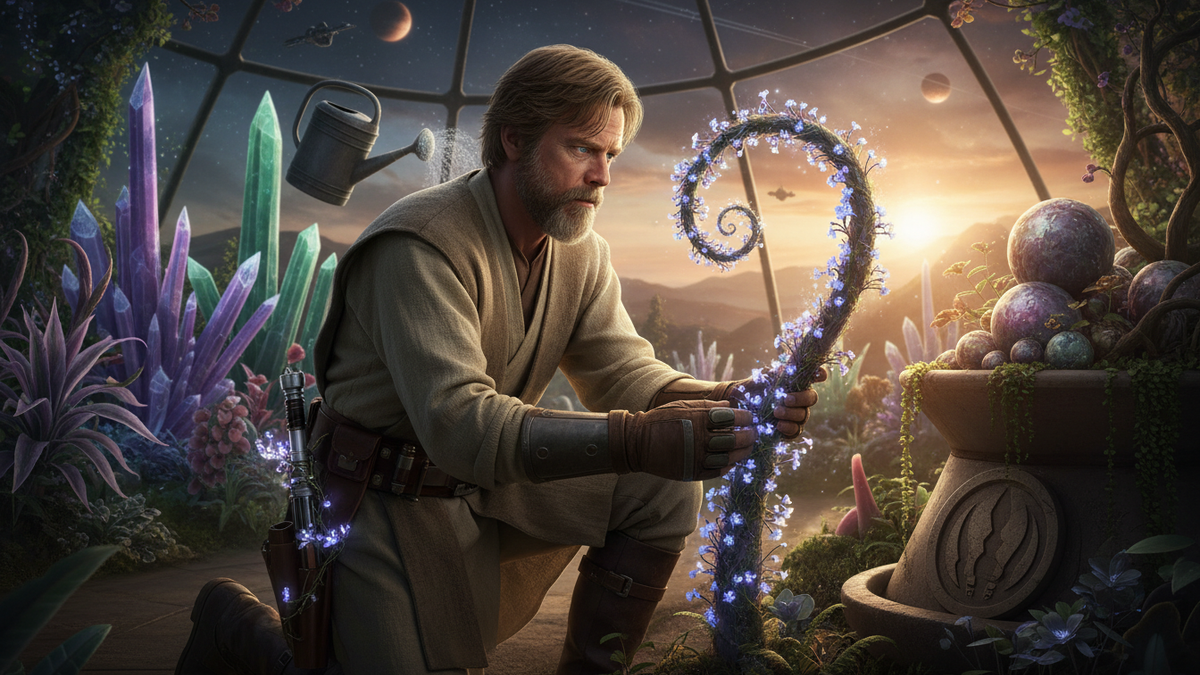
Luke Skywalker: The Intergalactic Gardener
On a small moon orbiting a peaceful planet in the Outer Rim, Luke Skywalker kneels in rich soil, carefully tending to a Alderaanian sunflower—one of only three known to still exist in the galaxy. His hands, once gripped around a lightsaber, now nurture roots and stems with equal dedication.
“The Force flows through all living things,” Luke says, gently adjusting a support stake. “I understood that intellectually for years. But I didn’t really feel it until I started working with plants. They’re patient teachers, if you’re willing to listen.”
The transition from Jedi Master to gardener surprised everyone, including Luke himself. After years of trying to rebuild the Jedi Order, facing darkness and loss, he found himself burned out and questioning his path. A botanist friend suggested he try growing something, anything, just to ground himself.
“I thought she meant meditation. She literally meant putting my hands in dirt. I was skeptical. Then I planted my first seed and felt… peace. Real peace. Not the absence of conflict, but something deeper. Connection to life in its simplest, most fundamental form.”
His gardens have become something between a botanical preserve and a living meditation space. Luke cultivates rare and endangered plants from across the galaxy, many from worlds devastated by the Empire’s destruction. Each plant represents both preservation and hope.
“When Alderaan was destroyed, so much was lost. Not just people, but entire ecosystems. These sunflowers are descendants of seeds that were offworld when it happened. Growing them feels like keeping a promise to everyone we couldn’t save.”
The work is scientific and spiritual in equal measure. Luke has partnered with xenobotanists to understand the unique properties of different species, while also exploring how the Force interacts with plant life. His journals document both growth patterns and meditative insights.
“Plants exist entirely in the present moment. They respond to current conditions—light, water, nutrients—without worrying about yesterday or tomorrow. It’s the most natural form of mindfulness. Spending time with them teaches you to do the same.”
He’s also developed workshops teaching gardening as a meditative practice. Students from various backgrounds—former soldiers dealing with trauma, young people seeking purpose, even a few Force-sensitives looking for alternative training—come to learn his methods.
“I don’t teach the Force, exactly. I teach presence. How to listen to something that doesn’t speak in words. How to respond to needs without overthinking. How to accept that despite your best efforts, sometimes things die, and that’s okay too. These lessons happen to be useful for both gardening and everything else.”
The gardens themselves are designed as living spaces for contemplation. Winding paths move visitors through different environments—a section of desert plants from Tatooine, a humid area featuring Dagobah swamp flora, a grove of trees from forests across the galaxy. Each area invites different forms of reflection.
Luke’s most ambitious project is the Restoration Garden, where he’s working to recreate extinct ecosystems in miniature. It’s painstaking work requiring years of research and careful cultivation, with no guarantee of success.
“This might be impossible,” Luke admits, examining a struggling seedling. “These species evolved together in balanced systems we can’t fully replicate. But impossible isn’t the same as not worth attempting. Even if we only partially succeed, we learn something valuable.”
He’s found unexpected parallels between gardening and his Jedi training. Both require patience, observation, and acceptance of things beyond your control. Both demand you remain present while planning for future growth. Both teach that forcing outcomes often does more harm than good.
“Yoda used to say, ‘Do or do not, there is no try.’ I understand that differently now. In the garden, you absolutely try. You create conditions, you nurture, you hope. But ultimately, the seed decides if it will grow. Your job is to show up consistently and pay attention. The outcome isn’t entirely in your hands.”
Between tending his gardens, Luke has been documenting traditional ecological knowledge from elder species across the galaxy—methods of working with land that the Empire tried to erase. This work feels like another form of rebellion, preserving wisdom that was targeted for destruction.
He’s also maintained connections with the few remaining Force-sensitives, though his guidance now looks different. Instead of formal training, he invites them to garden with him, teaching through shared work rather than instruction.
“The Force isn’t something you master. It’s something you participate in. Plants taught me that. They’re part of the Force’s flow without trying to control it. They just grow, and trust, and respond to what comes. That’s the lesson I wish I’d learned earlier.”
His days follow natural rhythms now—dawn watering, midday research and cultivation, evening meditation among the growing things. It’s not the dramatic purpose he once imagined for himself, but it’s deeply satisfying in ways his younger self wouldn’t have understood.
“I used to think my job was to save the galaxy. Big, dramatic interventions. Now I think maybe it’s to tend a small piece of it with great care. To preserve what was lost, nurture what’s struggling, and create beauty in whatever corner I can reach. That might not sound like much, but when you’re actually doing it? It’s everything.”