Katniss Everdeen: The Wildlife Advocate
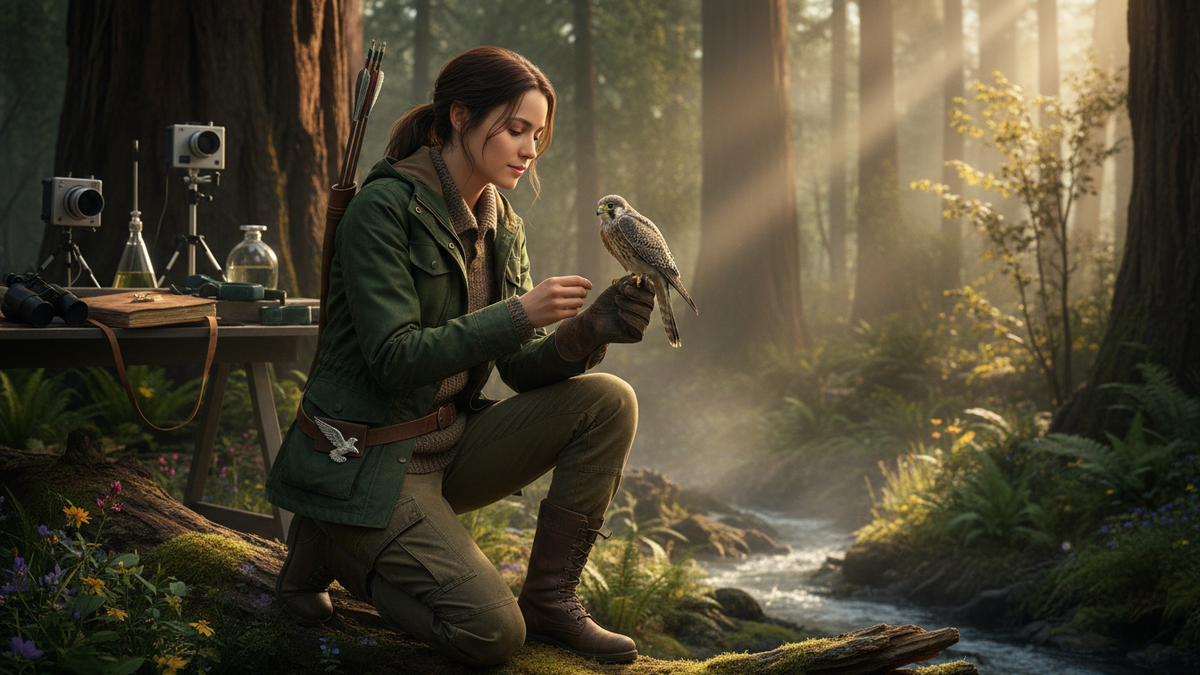
In a forest in what was once District 12, Katniss Everdeen moves silently through the undergrowth, checking camera traps and monitoring signs of wildlife recovery. The woods are slowly healing from decades of environmental damage, and she’s dedicated herself to helping that healing along.
“After the war, I couldn’t be in crowds. Couldn’t be in the Capitol, obviously. Could barely function most days,” Katniss says, adjusting a camera angle. “But here? In the woods? I could breathe. The animals don’t care about the Hunger Games or the rebellion. They’re just trying to survive. I understood that.”
Her work as a wildlife advocate began informally—simply spending time in the forests, observing, tracking, slowly remembering who she’d been before the Games made her a symbol. Local scientists noticed her expertise and offered a collaboration that gradually evolved into her life’s work.
“I didn’t have formal education. Still don’t, mostly. But I knew these woods better than anyone. I could track animals, predict their behaviors, identify subtle changes in the ecosystem. Turns out that knowledge was valuable. They taught me the science; I taught them how to actually find and observe the wildlife.”
The region’s ecology had been devastated by the Capitol’s extraction industries. Forests clear-cut, waterways polluted, animal populations decimated. The recovery is slow and requires constant effort—habitat restoration, protection from poaching, monitoring population health. Katniss has become the public face of these efforts.
“People listen to the Mockingjay in ways they wouldn’t listen to a random wildlife biologist. I hate using that symbol—it cost me everything I loved. But if it helps protect these animals and these forests, then fine. I’ll be the Mockingjay one more time.”
Her focus has been on apex predators and keystone species whose recovery indicates broader ecosystem health. She’s particularly invested in wolf restoration, seeing parallels between their family structures and her own fierce protectiveness of those she loves.
“Wolves mate for life. They protect their pack with everything they have. When a pack member dies, they grieve. We’re not so different. Except they don’t make a spectacle of it for entertainment.”
The work provides more than just purpose—it provides healing. Hours in the forest, focused entirely on something beyond herself, offers respite from the nightmares and memories that still haunt her. It’s not therapy exactly, but it helps in ways formal treatment never quite did.
“Out here, I’m not the girl on fire or the Mockingjay or a victor. I’m just someone who knows how to be quiet and patient. Who can read tracks and signs. Who belongs in these woods. That person existed before the Games. Working like this helps me remember her.”
She’s also developed environmental education programs for children in the districts, teaching outdoor skills and fostering respect for nature. Many of these kids have only known urban poverty or industrial zones. Showing them another way of being feels revolutionary.
“I take them into the woods. Teach them to identify trees, track animals, understand how ecosystems work. Some of them get it immediately—you can see them relax, like they’ve found a piece of themselves they didn’t know was missing. Those moments keep me going.”
Katniss has been documenting the recovery process meticulously, creating a record that will help other post-conflict regions restore their environments. The work is technical and precise, requiring a kind of focus that quiets the chaos in her mind.
“Every data point matters. Population counts, behavioral observations, evidence of breeding, migration patterns. Together they tell the story of whether we’re succeeding. Whether these species will survive. I owe them accuracy.”
Between fieldwork, she’s become an increasingly outspoken advocate for environmental protection, speaking at conferences and to government bodies. It’s uncomfortable—she still hates public speaking, still feels like an imposter. But she does it anyway.
“I’ve faced down the Capitol. I can face down a room of bureaucrats who want to open protected land to development. They’re betting I’ll stay quiet, stay traumatized, stay in the woods. But these forests don’t have another voice. So I speak up, even when it terrifies me.”
Peeta occasionally joins her in the field, documenting the recovery through art. His paintings of the restored forests hang in government buildings and schools, beautiful propaganda for conservation. They work well together in the quiet spaces, healing in parallel.
“We both needed work that felt real, that mattered beyond symbols and politics. His paintings, my research. Creating instead of destroying. Protecting instead of fighting. It’s not a cure, but it’s something to build on.”
Her most ambitious current project involves creating wildlife corridors connecting protected zones across multiple districts. It requires coordinating with various governments and interest groups—complicated work that forces her to engage with the political world she’d rather avoid.
“I told them I was done being political. They reminded me that everything is political, including whether animals have space to migrate. I hate that they’re right.”
Looking ahead, Katniss sees decades of work still needed. The forests won’t fully recover in her lifetime, but the trajectory is positive. Species are returning. The ecosystem is rebalancing. It’s enough to keep going.
“People ask if I’m happy. I don’t know how to answer that. But standing in these woods, watching a family of deer that shouldn’t exist anymore graze peacefully? That feels like something. Maybe not happiness exactly, but purpose. Rightness. Like I’m finally doing what I was meant to do all along.”
As sunset approaches and she prepares to head home, Katniss pauses to watch a mockingjay’s flight through the trees—the real bird, not the symbol. It sings its complex song, indifferent to everything it once represented. She listens until it falls silent, then continues on her way.