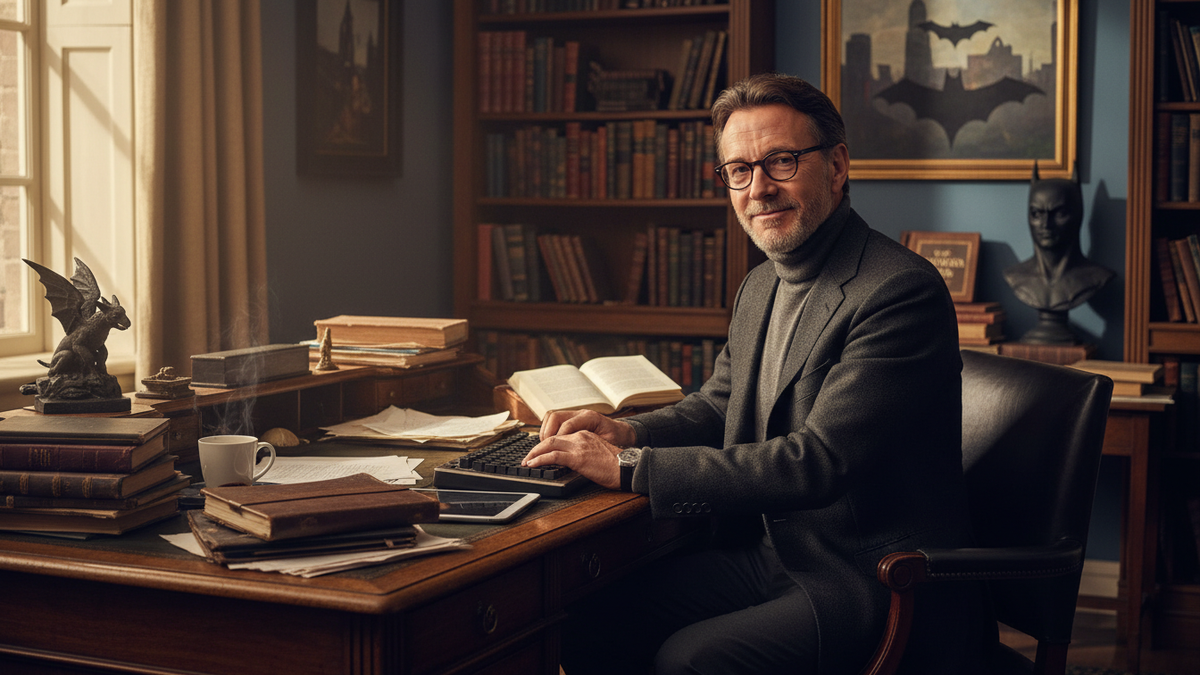
Batman: The Dark Knight Turned Writer
In Wayne Manor’s library, Bruce Wayne sits at the desk where he once planned operations against Gotham’s criminals, now planning plot twists and character arcs. His latest manuscript sits beside him—the fifth novel in a series that has captivated readers while hiding its author’s true identity behind a pseudonym.
“I never intended to become a writer,” Bruce admits, reviewing notes on a complex timeline. “I kept journals throughout my years as Batman—detailed case files, psychological observations, tactical analyses. After I retired, Alfred suggested I might channel that documentation into something constructive. I thought he was joking.”
He wasn’t. The journals contained decades of material—investigations that read like intricate puzzles, character studies of Gotham’s rogues gallery, meditations on justice and morality. Alfred convinced Bruce that these experiences, properly fictionalized, could offer insights to readers while finally giving Bruce a way to process trauma through narrative control.
“The first book took three years to write. I kept getting lost in perfectionism, obsessing over details the way I obsessed over cases. Alfred finally told me that if I didn’t finish it, he’d publish the journals as-is. That motivated me.”
The novels follow a detective in a city that resembles but isn’t quite Gotham, solving cases that mirror Bruce’s own experiences with names and details changed. Critics praise the psychological complexity and moral ambiguity. They have no idea they’re reading heavily disguised memoirs.
“My protagonist makes mistakes. Questions his methods. Struggles with the line between justice and vengeance. These aren’t abstract considerations—they’re questions I lived with every night for decades. The fiction gives me distance to explore them honestly.”
Writing under a pseudonym was essential. Bruce Wayne publishing crime novels would attract the wrong kind of attention and speculation. But the anonymity also provides creative freedom—readers judge the work on its merits, not his biography.
“As Bruce Wayne, everything is scrutinized, analyzed, reduced to my family’s tragedy or my public persona. As B.K. Night? I’m just a writer. People discuss the themes and characters, not me. It’s remarkably liberating.”
The research for his novels is meticulous, drawing on his extensive knowledge of criminal psychology, forensics, and urban systems. But he’s also consulting with active detectives, social workers, and reformed criminals to ensure contemporary accuracy and perspectives beyond his own experience.
“My vigilante years gave me one view of crime and justice. But that perspective was limited, shaped by privilege and trauma. I need other voices to write something truthful. To show systems, not just individual bad actors.”
His third novel dealt with police corruption, drawing heavily from his complicated relationship with the GCPD. It sparked conversations about institutional reform and got him invited to speak (anonymously, via video) at criminal justice conferences.
“I couldn’t fix those systems as Batman. Punching bad cops doesn’t reform a department. But writing about the systemic issues, showing how corruption self-perpetuates? That reaches people who need to understand it. Policy makers, citizens, even honest cops looking for language to describe what they’re up against.”
The writing process itself has become therapeutic in ways Bruce’s millions spent on other treatments never quite achieved. Shaping narrative, controlling outcomes, deciding who gets justice—it provides closure his real cases often lacked.
“So many cases ended ambiguously. Criminals disappeared, evidence was insufficient, victims never got full closure. In my novels, I can provide resolution. Not always happy endings—that would be dishonest. But resolution. Completion. That matters more than I expected.”
He’s also enjoying the craft itself—learning to build suspense, develop characters beyond their utility to plot, write dialogue that sounds natural rather than tactical. His early drafts were apparently terrible in these aspects. His editor (who doesn’t know his identity) provided feedback he describes as “humbling.”
“She sent back my first manuscript with a note: ‘You write action scenes beautifully and your plotting is meticulous, but your characters don’t sound like humans having conversations.’ She was right. I’d spent so long wearing masks and speaking in careful codes, I’d forgotten how normal people talk. I’m still learning.”
Between novels, Bruce has been working on a non-fiction book about trauma, recovery, and finding purpose after loss. It’s more personal and therefore more difficult. He’s not sure he’ll publish it, but the writing itself feels necessary.
“Fiction lets me hide behind characters. This other book? It’s closer to the truth. How someone who experiences tragedy can channel it into purpose, but that purpose can become destructive if you’re not careful. How you eventually have to choose between the mission and actually healing. I don’t have all the answers, but I have questions worth asking.”
Alfred serves tea and offers dry commentary on plot holes, filling a role somewhere between butler, editor, and therapist. Their collaboration is comfortable in ways their Batman-Alfred dynamic never quite was.
“He reads every draft. Points out when I’m being self-indulgent or when my protagonist is too obviously me. Tells me when something rings false. He’s brutally honest, and it makes the work better. This is the partnership we should have always had.”
Looking ahead, Bruce is planning a standalone novel about rehabilitation and second chances, inspired by his complicated relationships with people like Harvey Dent and Selina Kyle. It’s ambitious and emotionally risky.
“The detective series is successful and relatively safe. This new book asks harder questions about forgiveness and redemption. Whether people can truly change. Whether they deserve the chance. I don’t know if readers want that from B.K. Night, but I need to write it anyway.”
As evening settles over Gotham, visible through the library’s tall windows, Bruce returns to his manuscript. The city he spent decades protecting is still there, still struggling, still complicated. But he’s found a new way to serve it—not through fear and force, but through stories that might help people understand themselves and each other a little better.
“I was the Dark Knight for a long time. Maybe now I can be something else. Someone who shines light on darkness through understanding rather than intimidation. It’s not as dramatic. But it might be more useful in the long run.”