Arya Stark: The Cultural Explorer
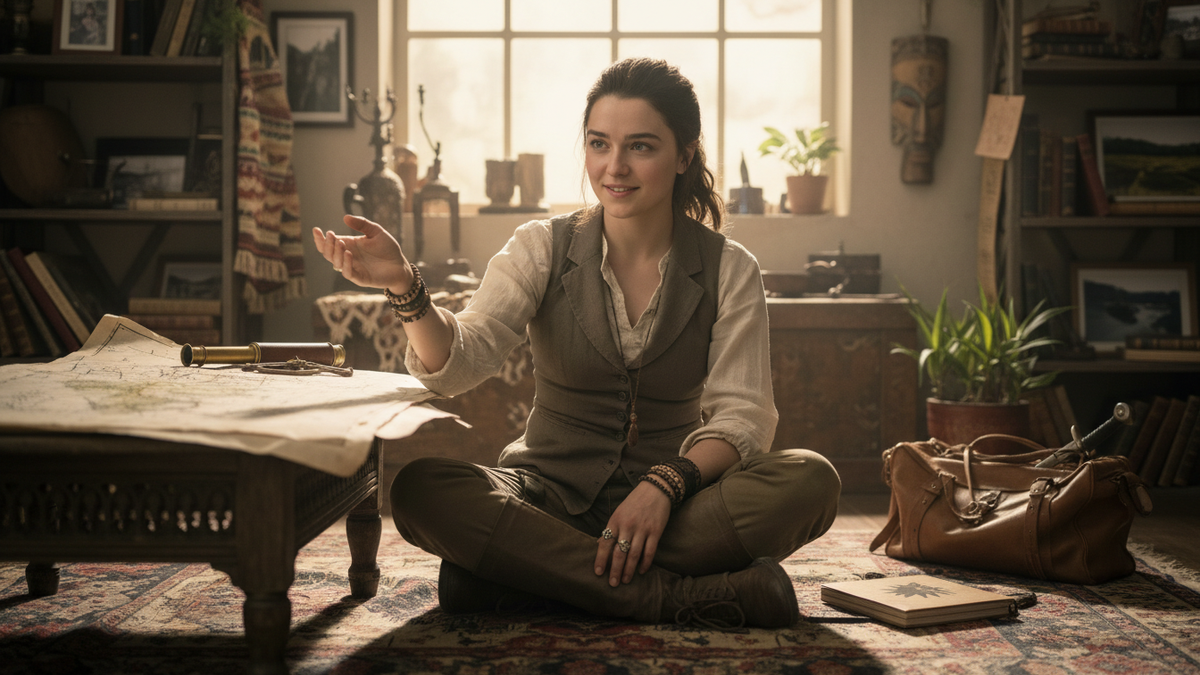
Arya Stark sits cross-legged on a worn cushion in a tea house in Yi Ti, thousands of miles from Winterfell. Before her is a notebook filled with sketches, observations, and carefully transcribed oral histories. She’s been on the road for five years now, and she’s never been more certain she’s exactly where she needs to be.
“After everything ended, people expected me to settle down. Marry someone, manage a holdfast, become a proper lady. But I’d spent years learning to be no one. I needed to figure out who I actually was, and I couldn’t do that in Westeros. Too many expectations, too much history.”
Her journey began as simple wandering—the “What’s west of Westeros?” question she’d posed to Lady Crane had never really left her mind. But curiosity evolved into something more purposeful when she realized how little she actually knew about the world beyond conflict and survival.
“I’d been trained as a Faceless Man. I could become anyone, slip into any culture. But I’d never actually understood those cultures. I’d mimicked surfaces without learning depths. I wanted to do it properly this time—to actually see people, not just wear their faces.”
Her explorations focus on what she calls “ordinary magic”—not the dramatic sorcery of Red Priests or the Others, but the everyday practices that give communities meaning. Traditional crafts, storytelling methods, food preparation rituals, coming-of-age ceremonies. The cultural knowledge that often gets erased in history books focused on wars and kings.
“Everyone writes about battles and treaties. But how people actually live? The grandmother teaching her granddaughter to weave in a particular pattern passed down for generations? The songs they sing while fishing? Those stories are disappearing, and nobody thinks they’re important enough to preserve.”
She’s developed a methodology that combines respectful observation with active participation. Arya doesn’t just watch; she learns to do. She’s apprenticed with a blacksmith in the Summer Isles, studied textile arts in Lys, learned traditional cooking methods from grandmothers in Qarth. Each skill gives her insight into how people think and what they value.
“The Faceless Men taught me to observe details. But they taught me to use that for deception. Now I use those same skills for understanding. I watch how a master teaches an apprentice, what corrections they make, what aspects they emphasize. It tells you what that culture considers essential.”
Her notebooks have grown into a substantial archive. Detailed illustrations of traditional patterns, transcribed songs and stories, recipes, craft techniques, philosophical concepts that don’t translate directly into the Common Tongue. She’s also commissioned local artists to contribute, ensuring perspectives beyond her own.
The work has changed her understanding of identity itself. Growing up, Arya defined herself in opposition to expectations—not Sansa, not a lady, not what people wanted her to be. Now she’s building a positive sense of self drawn from multiple influences.
“I’m not trying to become these cultures. That would be another form of being no one. But I’m letting them shape me, teach me, expand what I think is possible. I’m Arya Stark, and I’m also all these experiences. They don’t contradict each other.”
She’s also become increasingly aware of how her own perspective shapes what she sees. As a wealthy foreigner from a powerful family, some doors open easily while others remain closed. She’s had to learn humility and when to step back.
“A woman in Asshai told me, politely but firmly, that some knowledge isn’t for outsiders. She wasn’t being cruel—she was protecting something sacred. Old Arya would have been angry, would have found a way to learn it anyway. Now I understand that some boundaries deserve respect. Not everything is mine to know.”
Her travels have also involved confronting Westeros’s impact on the wider world. The reach of her family’s name, the scars left by Westerosi colonization and slave trading, the assumptions people make about her based on where she’s from. It’s been uncomfortable and necessary.
“I represent a continent that has caused real harm in these places. Sometimes people don’t want to talk to me because of that, and they’re right to feel that way. I can’t separate myself from that history. I can only acknowledge it and try to learn anyway.”
She’s planning to eventually return to Westeros, though not to stay. Her goal is to establish a cultural archive and exchange program, bringing scholars and artists from around the world to share knowledge. It’s ambitious and will require resources she’ll need to negotiate for.
“Westeros is so isolated, so convinced of its own importance. We could learn so much from other places. And they could benefit from sharing too—cultural exchange, not extraction. It’ll be complicated to set up, but worth doing.”
Between her travels, Arya maintains connections back home through letters. Sansa finds her work fascinating and has already offered support for the archive. Jon is confused but supportive. Gendry sends her new sketch pencils and asks when she’s coming home. She doesn’t have an answer yet.
“Part of me will always belong to Winterfell. But part of me belongs to the road now, to the next conversation, the next thing I don’t know yet. I’m not running away anymore. I’m running toward something. Understanding, connection, growth. That feels right in a way settling down never did.”
As she prepares to leave for her next destination—a chain of islands known for their unique astronomical traditions—Arya reflects on the girl she was and the woman she’s becoming.
“I used to have a list of names. People to find, to punish. Now I have a different kind of list—traditions to learn, stories to preserve, connections to make. It turns out the question isn’t ‘What’s west of Westeros?’ It’s ‘What can I learn from every direction?’ And the answer is: more than I could explore in ten lifetimes. But I’m going to try anyway.”